The Reality of the “Gel Hangover”
We have all been there. You sit down to remove a three-week-old manicure, and instead of the smooth surface you expected, you are met with “paper-thin” nails that feel sensitive to the touch. It’s a bit of a shock, isn’t it? The realization hits: your natural nails are peeling, white-spotted, and incredibly brittle. If you are searching for how to restore nails after gel polish, you are definitely not alone.
While gel manicures offer undeniable convenience, the removal process—often involving aggressive scraping and prolonged acetone exposure—can leave the nail plate severely dehydrated. To be honest, rebuilding that strength isn’t about a “quick fix” or a magic bottle of clear polish; it is a dedicated process rooted in science and consistent care. I’ve noticed that those who rush the process usually end up right back where they started.
Why Your Nails Need a Serious Reset
When you wear gel for long periods, the nail plate is sealed off. When that seal is broken during removal, it often takes microscopic layers of the dorsal (top) nail layer with it. This leads to issues that go beyond just how your hands look:
- Structural Integrity: A damaged nail plate is prone to “splitting,” which can lead to painful tears in the nail bed.
- The “Gel Cycle” Trap: Many women immediately apply more gel to hide the damage, which further suffocates the nail. It’s a tempting cycle to fall into, but it’s a recipe for chronic thinning.
- Long-term Growth Impact: Constant trauma to the nail matrix can lead to permanent ridges or irregular growth patterns.
Common Recovery Pitfalls to Watch Out For
Before we dive into the recovery steps, we have to talk about the habits that stall your progress. If you want to effectively restore nails after gel polish, stop doing these things immediately:
1. The “Peeling” Temptation
Picking or peeling off gel polish is the cardinal sin of nail care. When you peel the polish, you are physically ripping away keratin. This is the primary cause of those white, flaky patches. One thing I noticed is that we often do this when we’re stressed without even realizing it—keep a fidget toy nearby instead!
2. Over-Buffing the Damage
It is tempting to buff away the rough texture. However, your nails are already too thin. Buffing further reduces the thickness, making them even more fragile and sensitive.
3. Relying on Harsh “Hardeners”
Many traditional “nail strengtheners” contain high levels of formaldehyde. While this makes the nail feel hard instantly, it makes them too rigid. Rigid nails lack “give” and will snap at the slightest impact.
A Personal Note: The Psychology of “Naked” Nails
I’ll be the first to admit: going without polish for a few weeks feels strange. Our hands feel “unfinished.” But in fact, this mental hurdle is often the biggest obstacle to recovery. Think of this as a “nail sabbatical.” It’s not about being unpolished; it’s about giving a living part of your body the air it needs to breathe and heal. I found that keeping them short and neatly filed makes the transition much easier to handle visually.
The Step-by-Step Guide to Restore Nails
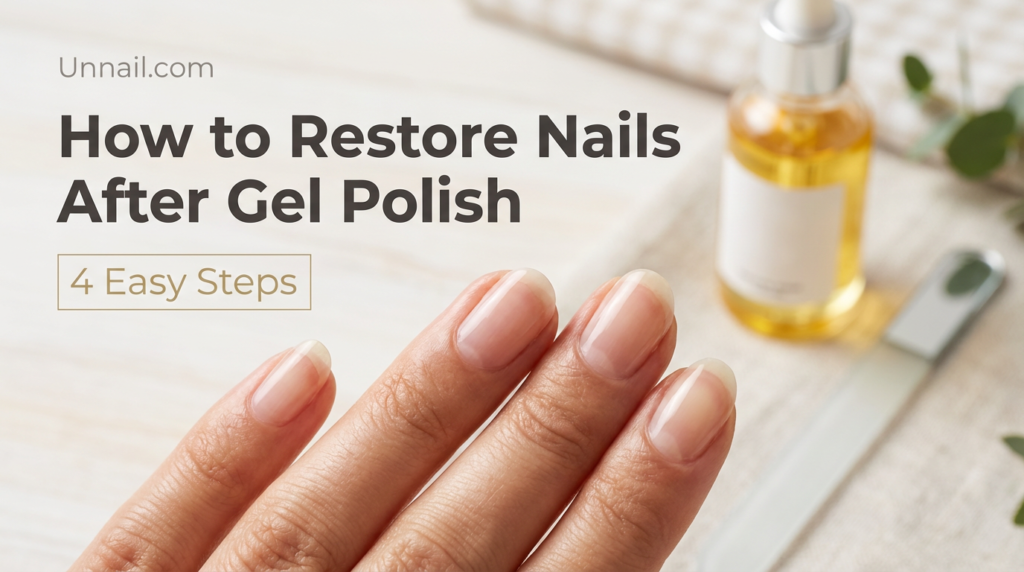
This 4-to-6 week protocol is a reliable way to transition your nails from damaged to resilient.
Step 1: Commit to the “Naked” Phase
Stop all aggressive treatments for at least one full growth cycle. Your nails need oxygen and a break from the constant cycle of dehydration.
Step 2: Trim and Reshape Safely
Keep your nails short and rounded. Use a high-quality glass nail file and file in one direction only to prevent micro-tears in the keratin layers.
Step 3: The “Hydration First” Protocol
Apply Jojoba-based oil 2–3 times a day. Jojoba has a molecular structure small enough to actually penetrate the nail plate, unlike many thicker oils that just sit on top.
Step 4: Use a Keratin-Building Treatment
Instead of a hardener, look for a repair treatment like the UNNAIL Bio-Keratin Rescue Serum. These formulas use plant-based keratin to fill in the microscopic gaps left by gel removal.
Understanding the Science of the Nail Cycle
To truly understand how to restore nails after gel polish, you have to look at the timeline. A fingernail takes approximately 3 to 6 months to grow from the cuticle to the tip. This is why patience is your best friend here. Dermatologists often recommend “cyclic loading” of moisture—alternating between hydrating oils and protein-based strengtheners—to mimic the nail’s natural composition.
The “half-moon” at the base (the lunula) is the visible part of the nail matrix. Any damage here can cause permanent ridges. This is why we advocate for gentle, non-toxic care; harsh chemicals can seep into the matrix and affect the nail before it even emerges.
Smart Swaps for Long-Term Health
When you’re ready to dip your toes (or fingers) back into the world of color, consider these alternatives that I’ve found to be much kinder to the nail plate:
- Glass Files over Emery Boards: They seal the keratin layers rather than shredding them.
- Soy-Based Removers: Swap standard 100% acetone for oil-based removers. They take a bit longer, but they don’t turn your fingers white with dehydration.
- 10-Free Polishes: Look for formulas that exclude toxic chemicals like formaldehyde and DBP.
FAQ: Real Answers for Damaged Nails
How long does it really take to see progress?
Typically, you will see a visible improvement in 2 to 4 weeks. However, for a complete recovery—where the damaged portion is entirely grown out—it takes roughly 3 to 6 months.
Are biotin supplements worth it?
Studies suggest that biotin can increase nail thickness over time. In my experience, it works best when taken consistently over a 3-month period, but always check with your doctor first.
Can I wear any polish at all during recovery?
It is highly recommended to go “naked” for at least 7–14 days. If you absolutely must wear polish, choose a “breathable” formula that allows moisture to reach the nail plate.
Rebuild, Don’t Rush
Learning how to restore nails after gel polish is a journey of patience. There are no shortcuts to biological growth. By removing toxic chemicals and focusing on deep hydration, you are giving your body the environment it needs to thrive. Your natural nails have the potential to be strong and beautiful again—it’s just time to let them breathe for a while.