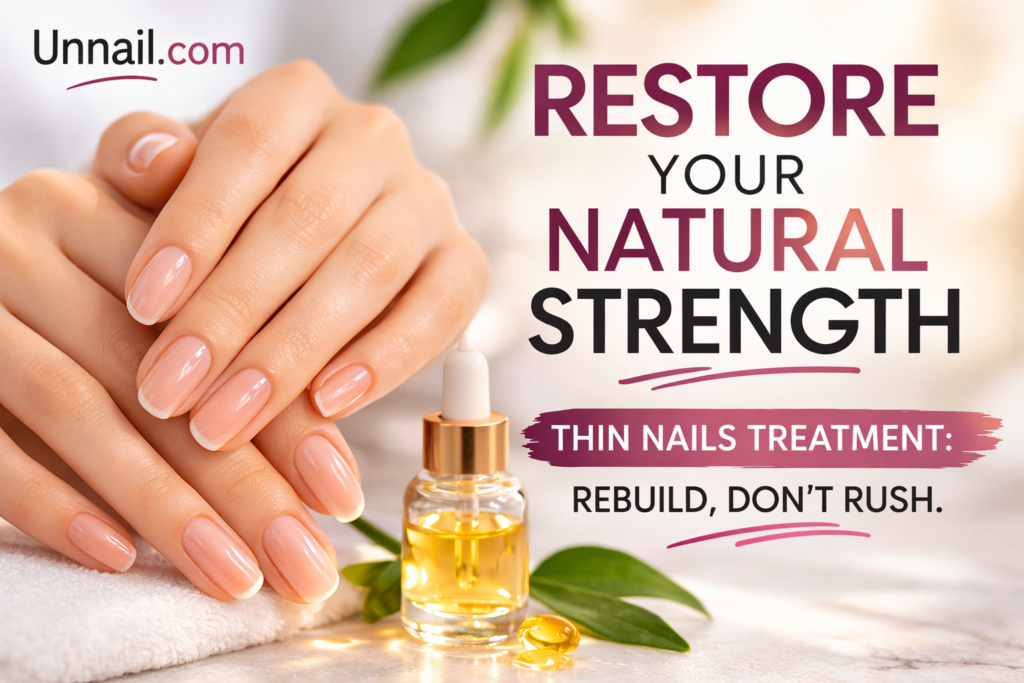
Thin Nails Treatment: The Ultimate Guide to Restoring Natural Strength
You look down at your hands and see them: thin, peeling, almost translucent tips that bend at the slightest touch. It’s a familiar sight for anyone who has just moved on from a long-term relationship with acrylics or gel polish. To be honest, the frustration of “paper-thin” nails isn’t just about how they look; it’s about that uncomfortable, tender feeling when your natural shield is gone.
Finding an effective thin nails treatment is about more than aesthetics. It’s about biological restoration. Many women fall into the trap of seeking quick fixes—applying more polish to “hide” the damage—only to find their nails getting weaker underneath. True recovery doesn’t happen behind a layer of UV-cured plastic. It happens through a dedicated, science-backed approach that honors the natural growth cycle. At UNNAIL, we believe healthy nails are rebuilt, not rushed. Let’s walk through the professional steps to move from brittle to beautiful.
Common Nail Recovery Mistakes to Avoid
Before we dive into the routine, we have to talk about the habits that are likely sabotaging your progress. One thing I noticed is that people often try too hard, and that extra effort actually causes more harm.
1. The Nail Hardener Trap
Most over-the-counter “hardeners” contain formaldehyde. While this makes the nail feel hard instantly by cross-linking keratin fibers, it actually makes them incredibly brittle. Think of it like a piece of glass versus a piece of plastic; glass is hard, but it shatters. Healthy nails need to bend, not snap.
2. Over-Buffing
If your nails are already thin, the last thing they need is a buffer. Buffing removes the few remaining layers of keratin you have left. It might make them shiny for a day, but you’re literally sanding away your recovery.
3. Peeling Your Polish
Picking off gel or “peeling” a lifting acrylic set is equivalent to ripping off layers of your skin. It is the number one cause of surface trauma I see in the studio.
4. Skipping the Cuticle
Your cuticle is the seal that protects the new nail growing underneath. If you nip them too close or ignore them, you invite bacteria and prevent healthy growth from the source.
The Best Thin Nails Treatment: A 5-Step Recovery Routine
Restoring your nails requires a shift in mindset. You are now in “recovery mode.” Follow this nail strengthening routine for at least 12 weeks—that’s roughly the time it takes for a brand-new nail to grow from the cuticle to the tip.
1. The “Naked” Phase
Stop all aggressive treatments immediately. For the first 2–4 weeks, your nails should remain free of gel, acrylic, and heavy traditional polish. They need to re-equilibrate their moisture levels without a barrier.
2. Strategic Trimming and Shaping
Long, thin nails are prone to snagging. Keep your nails short—just at the tip of the finger—and use a glass nail file. Filing should always be done in one direction to prevent the keratin layers from fraying like a rope.
3. The Cuticle Oil Protocol
This is the most critical part of brittle nail care. Apply a high-quality https://unnail.com/blog/post-salon-nail-recovery-best-cuticle-care-routine containing Jojoba or Squalane at least three times a day. Jojoba oil is one of the few oils with a molecular structure small enough to actually penetrate the nail plate.
4. Apply a Nail Protein Cream
Unlike standard lotions, a nail protein cream is designed to deliver amino acids and lipids directly to the surface. Look for hydrolyzed keratin or wheat protein to help fill in the microscopic gaps in a damaged nail plate.
5. Internal Nutritional Support
Your nails are a reflection of your internal health. To optimize growth, ensure you are getting Biotin (B7), Collagen, and enough Iron and Zinc. Deficiencies in these minerals often manifest as thin, spoon-shaped nails.
The Science of Nail Plate Damage
The nail plate is made of approximately 50 to 100 layers of compacted keratin cells. When you wear acrylics, the prep process often involves filing down these layers to create a “grip.” If the removal is aggressive, you lose even more of that essential structure. This leads to:
- Increased Sensitivity: The nail bed becomes tender because the shield is too thin.
- Chronic Peeling: Layers of keratin begin to lift away, making it impossible for polish to stay on.
- The “Oily Nail” Myth: Often, thin nails feel flexible or “wet,” which people mistake for health. In reality, they lack the rigid protein structure needed to maintain a shape.
Ignoring a professional weak nails repair protocol can lead to permanent damage to the nail matrix. In fact, if the matrix is constantly traumatized, you may experience permanent ridges or even onycholysis, where the nail lifts from the bed.
A Personal Note on Patience
I’ve noticed that the biggest hurdle in nail recovery isn’t the products—it’s the boredom. We are so used to instant gratification with gels that waiting for a natural nail to grow feels like watching paint dry. In my experience, the people who succeed are the ones who turn their https://unnail.com/blog/post-salon-nail-recovery-best-cuticle-care-routine application into a tiny, mindful ritual. It’s not just about the oil; it’s about checking in with your body and giving it the time it needs to heal.
Clean Nail Care Swaps for Stronger Nails
To maintain your results, you must audit your kit. Traditional nail products are often loaded with harsh solvents that undo your hard work.
- Swap Acetone for Soy-Based Removers: Acetone strips every bit of oil from your nail. Soy-based removers are gentler and often infused with Vitamin E.
- Swap Emery Boards for Glass Files: Emery boards create micro-tears. A glass file seals the keratin as you file.
- Swap Traditional Polish for 10-Free Formulas: These exclude the most harmful chemicals like formaldehyde, toluene, and DBP.
The UNNAIL Longevity Score & Comparison
We use a 1–10 scoring system to evaluate products. Aim for products that score an 8 or higher for active recovery.
| Product Type | Repair Strength | Best For | Longevity Score |
|---|---|---|---|
| Traditional Hardener | High (Instant) | Occasional use only | 3/10 |
| Cuticle Oil | Medium (Long-term) | Daily maintenance | 10/10 |
| Nail Protein Cream | High | Post-acrylic recovery | 9/10 |
| Breathable Polish | Low | Transitioning back | 7/10 |
Buying Guide: What to Look For and Red Flags
When shopping for a thin nails treatment, marketing can be deceptive. I always tell my clients to flip the bottle over and read the fine print.
What to Look For:
- Breathable Formulas: These allow oxygen and water vapor to reach the nail.
- pH-Balanced: Maintains the natural acidity of the skin and nail.
- Hydrolyzed Keratin: This form is small enough for better absorption.
- Vitamin B5 (Panthenol): Excellent for moisture retention.
Red Flags (Avoid These):
- Formaldehyde/Formalin: Causes excessive dryness and brittleness.
- Toluene: A solvent that can irritate the respiratory system.
- Excessive Alcohol: Found in “quick-dry” products; highly dehydrating.
FAQ: Thin Nails Treatment & Recovery
How long does it take to repair damaged nails?
It typically takes 4 to 6 months for a nail to fully grow out. However, you will notice a significant improvement in strength and texture within 3 to 4 weeks of a consistent routine.
Can nails fully recover from gel damage?
Yes. Unless the nail matrix was permanently scarred, your nails will naturally regenerate. Most damage is surface-level stripping, which is manageable with the right care.
Should I stop wearing polish during recovery?
While a “naked” phase of 2 weeks is ideal, you can wear a 10-free, breathable base coat if your nails feel too vulnerable. It provides a physical shield while you focus on the cuticle.
Conclusion: Reclaiming Your Natural Strength
Treating thin nails is a journey of patience. Remember, there is no “miracle cure” that works overnight because your nails are limited by their natural growth rate. By implementing a dedicated treatment, switching to non-toxic products, and prioritizing hydration over harsh chemicals, you are setting the foundation for a lifetime of resilient nails. Healthy nails are rebuilt—not rushed. Start your journey back to natural strength today; your hands deserve it.